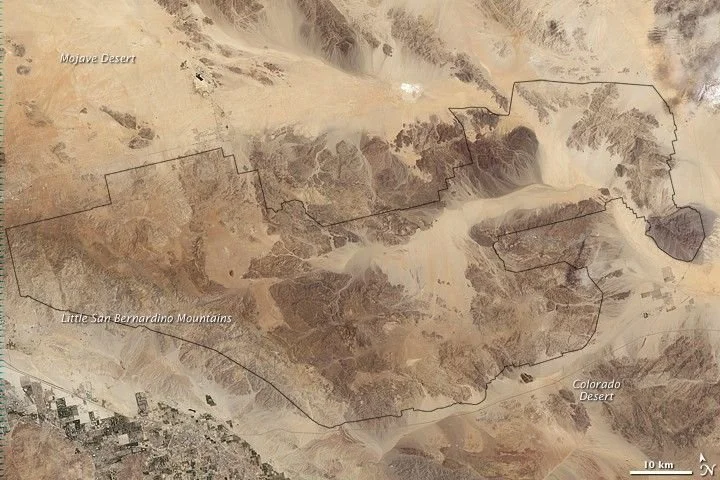
Satellite image of Little San Bernardino Mountains captured on May 28, 2003.
Earthen Matter
Organized by:
Jia Yi Gu, Assistant Professor of Architecture, Harvey Mudd College; Co-Director, Spinagu
Presented by:
Feminist Center for Creative Work as part of the community program Material Streams
Through hands-on workshops, walking tours, and discussions, this one-day workshop explores how earthen matter, material science, and modernist ideologies intersect.
The excursion begins with a two-hour hands-on adobe workshop, led by Ben Loescher of adobeisnotsoftware, an earthen education and advocacy organization. Participants will learn the foundations of clay to mix, form, and dry adobe by working directly with excavated soil to produce molded bricks. Participants will practice the ribbon and ball tests, field techniques long used by earth builders to read a soil's plasticity by touch. Unlike the laboratory instruments and classification charts of modern soil science, these tests locate knowledge in the hand. Fibrous materials such as straw contribute tensile strength while also helping to prevent cracking as bricks cure in the sun. Participants leave with an understanding of how particle size, moisture content, plasticity, and organic matter affect the behavior of earth as it is mixed, formed, compressed, and dried into adobe bricks.
The workshop is followed by a conversation between Jia Yi Gu and Ben Loescher exploring the history of adobe and regulatory systems. For much of the twentieth century, adobe sat outside the formal structures of California building code, which increasingly accommodated industrially manufactured, standardized materials whose properties could be tested and demonstrated through the methods of modern science. Because adobe’s composition varies from site to site and soil to soil, the earthen mixture often evaded modernist systems of material classification and was treated as a non-standardized building material. Without a prescriptive pathway for building, earthen building was effectively written out of use through incomplete building code, despite the fact that Indigenous people have utilized this technique for centuries in their architecture.
The day continues onto an adobe brick yard and a building-to-be. A walking tour of the adobe yard and future home of Yucca Valley Materials Lab explores an artist-founded center and a climate future of low-carbon and fire-resistant desert construction, and one of the first permitted adobe constructions in the region. Yucca Valley Material Lab envisions the adobe yard as a site where local soil is redirected as a material resource, providing an alternative to freighted supply chains of construction and shortening the distance between sites of geologic extraction and sites of temporary human use.
Land
Acknowledgement
The Mojave deserts of the Joshua Tree region are the homelands of the Serrano, Cahuilla, and Chemehuevi peoples. Their relationships with this land, its water sources, plants, and geologic cycles, long predate the arrival of contemporary adobe building tradition.
adobeisnotsoftware
Adobeisnotsoftware was founded in 2009 to inform, enable and advance adobe construction in California. They are the earthen education and advocacy arm of Terrain - a California-based architecture firm that specializes in earthen construction, adaptive reuse, high-performance workplace, and technical environments. We believe in the extraordinary potential of ordinary things.
Yucca Valley
Material Lab
Yucca Valley Material Lab (YVML) champions a decentralized, inclusive, and affordable model for art education grounded in direct material exploration. Located in the rural high desert community of the Morongo Basin, YVML offers a diverse range of core programs and services, including artist and musician residencies, workshops and public events.
Support
The day trip is organized with Harvey Mudd College’s Bioregional Design Research course, with six workshop spots available for the Feminist Center community as part of the community program Material Streams. The workshop and field trip is made possible with support from the the Harvey Mudd College Hixon Center for Climate and the Environment.