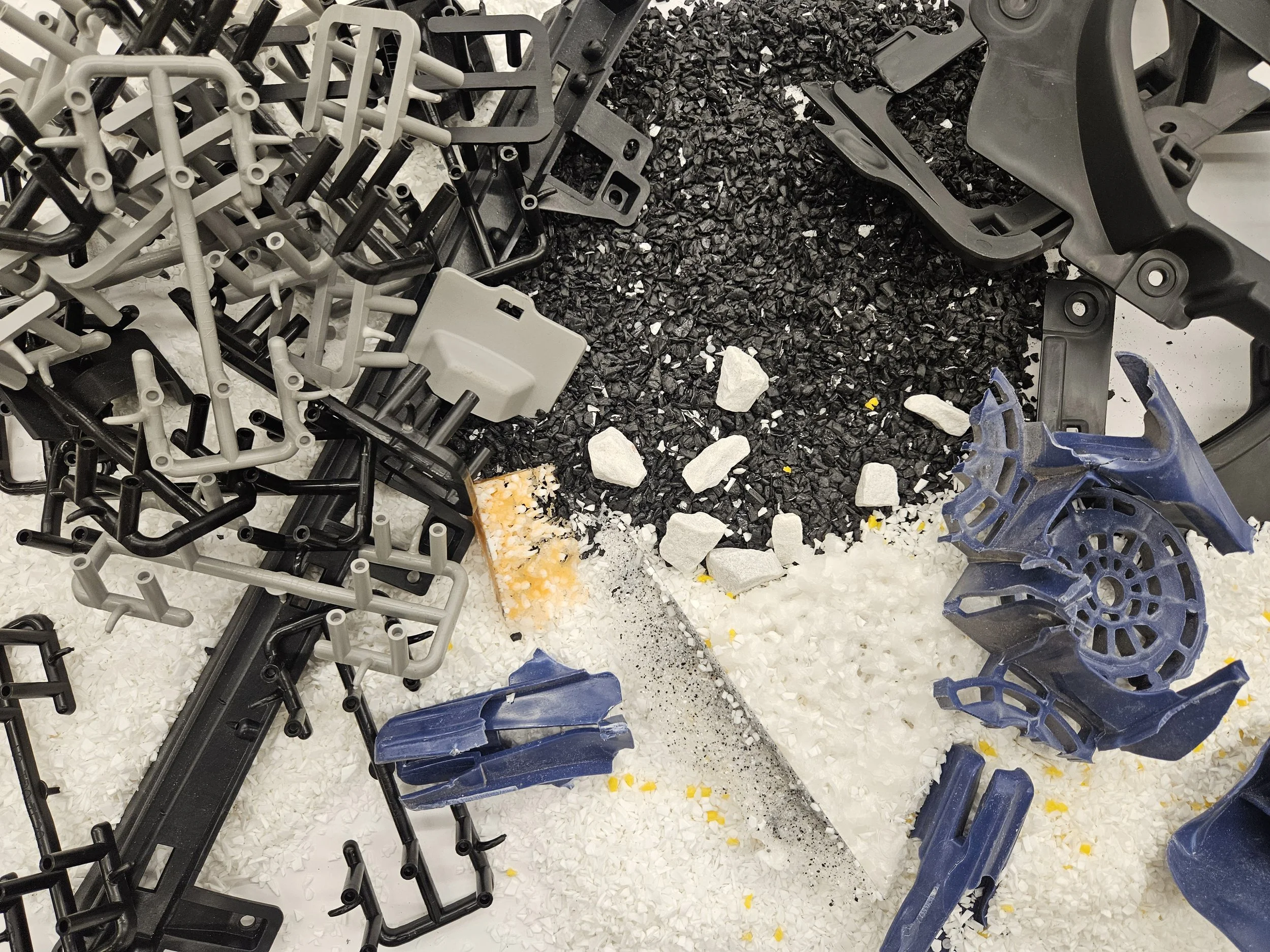
Photograph of plastics debris from Post Rock research. Courtesy of Post Rock.
Inhabiting Materials is a three-day intensive that gathers theoretical and practical engagements with material as a cultural technique. Through site-based lectures, parasitic readings, annotative drawing, and the gradual assembly of a portable material library, students will engage the regional material landscape alongside its practitioners, systems, and infrastructure. During the intensive, participants moves between xylariums, salvage sites, architectural details, and how-to guides to intensify our understanding of materials as processes.
THE CURRICULUM
Material Acts - Book and Exhibition Lecture
A presentation by Kate Yeh Chiu and Jia Yi Gu, curators and co-editors of the e-flux Architecture project Material Acts, to discuss their most recent publication and exhibition, “Material Acts: Experimentation in Architecture and Design.” Together, these projects examine the role of nature as a starting point for material experimentation in the domains of architecture, craft, and science.
Place-Based Lectures
“When Wood Became Technical” lecture by Jia Yi Gu at Michigan Xylarium
Lecture by Meredith Miller / Post Rock in site of extraction
Lecture by a contributor to Materialities of Empire
Lecture by discard studies/waste studies scholar in the Architectural Salvage Warehouse
Deconstructing a House: Annotative Drawing Workshop (4 hours)
Charlotte Malterre-Barthes re-drawn diagram of the deconstructed 2-4-6-8 House traces the provenance (or sources) of materials by accounting for their basic elements: aluminum, silica, copper, crude oil etc. This work politicizes the seemingly neutral information presented in architectural drawings by tracing them back to sites of extraction and industry. Working in groups of 4, students further annotate Charlotte Malterre-Barthes drawing with their own layer of information (labor, degradation, petrol lines, repair), researched together. These annotations will form a basis of understanding how domestic architecture is not only through the parts of assembly but the flows of energy, labor, resources, and time that account for architecture.
Parasitic Reading in Detail
Inspired by the Parasitic Reading Room, this event activates Taubman College of Architecture and Urban Design as itself a text, inviting participants to read and discuss material systems together. The program produces a spontaneous set of reading spaces in which select texts are read aloud in relation to a specific set of material assemblies found on site.
Material Feast
Lecture / Experimental Program
Material Feast is an interdisciplinary dialogue featuring designers and practitioners interrogating the contemporary role of materials in design. Framed as a "material feast"—a term that gestures toward abundance—each participant will offer a brief presentation of their practice using provisional objects and materials to probe the boundaries between art, science, design, and craft, inviting us to consider materials as processes rather than products.